ASSESSMENT & REPORTING
LITERACY ASSESSMENT TOOL
CHECKLISTS:
What: A checklist is an assessment tool that lists the criteria for evaluation. The criteria should reference the “learning standards” from the curriculum and include “I can” statements that outline what students should know in student centred language.
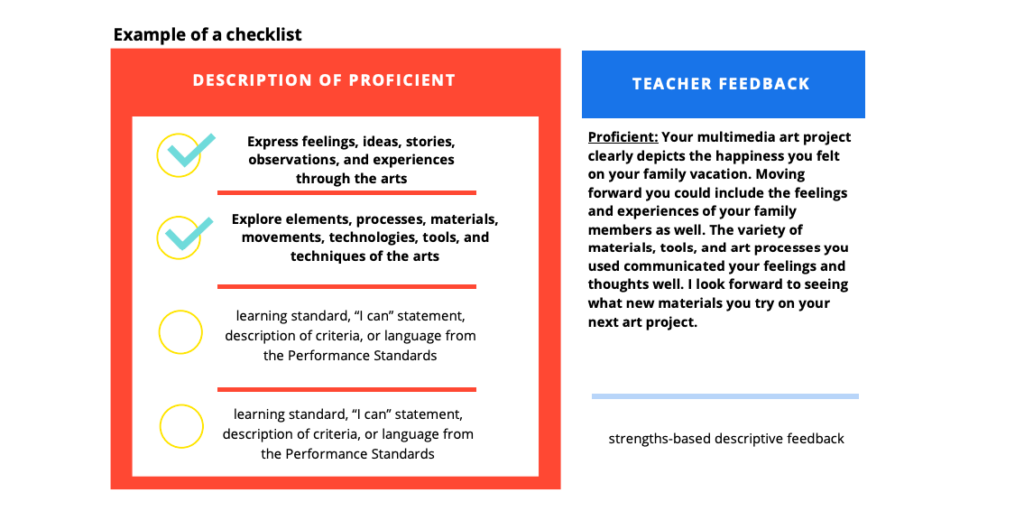
Why would you choose it: I would choose to use a checklist because:
- I think it is a tool that very clearly sets up what the expectation is for an assignment or project and almost acts like a to-do list and makes it very easy to apply to assignments.
- I feel like, a lot of times, the overall grade of an assignment outweighs the learning and feedback of the assignment. What I like about check lists is they allow the students to see what is expected and whether or not they have done it without putting the students on a scale and summing up their work with numbers – pairing a checklist with descriptive feedback I think would allow a student to see the feedback as positive suggestions and not statements of where the student went wrong
- I like the idea that it is either done or not done. Once you have completed that part of the assignment it is checked off
- I think it is good for scaffolding when you are first introducing students to creating their own rubrics and self-reflecting on their work, they can begin with: did I do that or did I not do that, before moving onto something that is more of a scale where students have to decide to what level or extent they have achieved something.
- I also really like that this is a tool students can take and use for themselves. It can be a strategy for them to organize their learning and expectations for other assignments.
One of the things I really like about checklists is I feel they would be easily adaptable and successful in any grade level. For example, as the teacher, you can break down each section/task into smaller pieces if that benefits your students so the assignment is very clear and not so overwhelming.
How and When might you use it: (including grade levels)
- Scaffolding to Self-Reflection / Self-Assessment: to get students used to the idea of reflecting on their own work and ensuring they have completed the assignment, I would like to start with a checklist because it requires a yes or no answer for each statement and students can determine if they feel like they have done what is being asked
- I want to try using checklists in my upcoming grade 6 practicum so students can monitor their own progress with assignments and make sure they have completed each criteria point as they are working. One of my lessons is from my Good Reads Assignment, where the students will be asked to write a haiku after reading the story “Sometimes I Feel Like A River”. I think for this, I would create a series of statements that the students could check on their own, like “My poem is a haiku, it has three lines, the first is five syllables, second is seven syllables, and the third is five syllables.”
In a way, checklists can be very basic. I feel like when using a checklist, the goal is for every student to be able to “check off” every item on the checklist. For a checklist to be effective then, it has to hold very specific, high standards so that when it is completed, the student is showing they are proficient.
I think then you have a few options for extending, I would include several options for students to reach extending. This would look like several “optional” checks that allow students to demonstrate additional learning/understanding/effort. Using my practicum example, an extending option may be “I wrote three haikus,” students may opt for this because they want to make their poem longer and felt they needed more syllables to convey their meaning.
I am torn with the idea of extending because in our assessment course, we’ve talked about how students should know the expectation and how they can achieve extending, but I also do not want to diminish creativity if students demonstrate extending in another way. Maybe I would allow students to create their own extending checklist point where they fill in a statement, “my project is extending because…” and they can explain what they learned and how they demonstrated it in each assignment.
Student Reporting Policy
Frequency of Reporting:
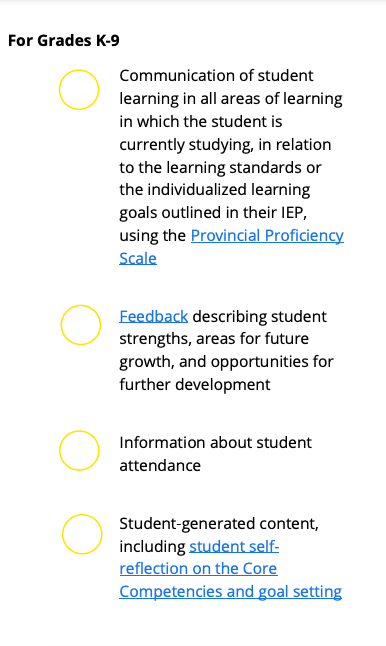
The requirements for reporting from Kindergarten to grade 12 are the same and call for a total of five communications throughout the year that provide information on a student’s learning.
- There must be four learning updates
- Two must be written, more formal learning updates, and can include digital or printed documents
- The other two can be more informal and do not have to be written. Other learning update types can be: conferences, phone calls, e-mails, portfolio entries or written summaries.
- And there must be a written summary of learning at the end of the school year.
At the beginning of each year, parents/caregivers should be informed of what and when the reporting will take place ie. what format is each learning update and when can they be expected. It may also be beneficial to tell parents learning updates reflect what students are currently learning, so if they have not yet started a subject or content area, it won’t be included on the learning update.
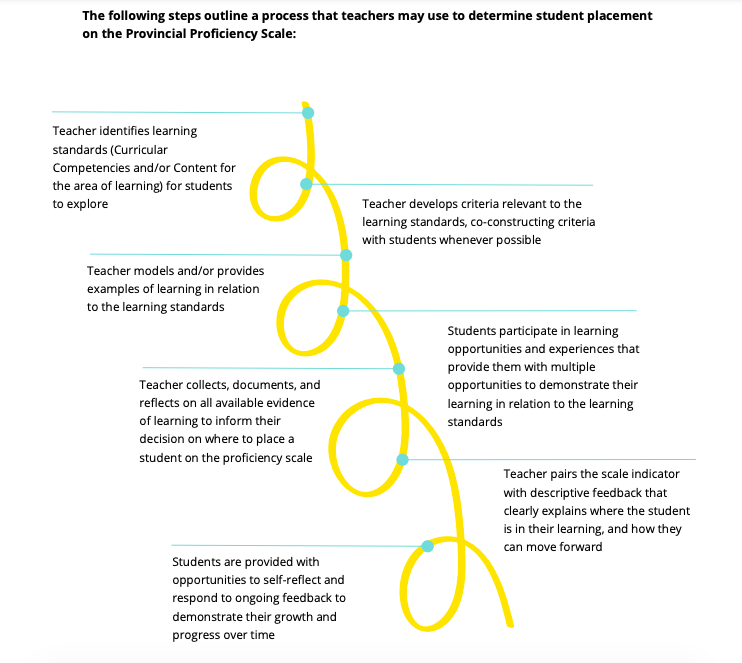
Proficiency Scale:
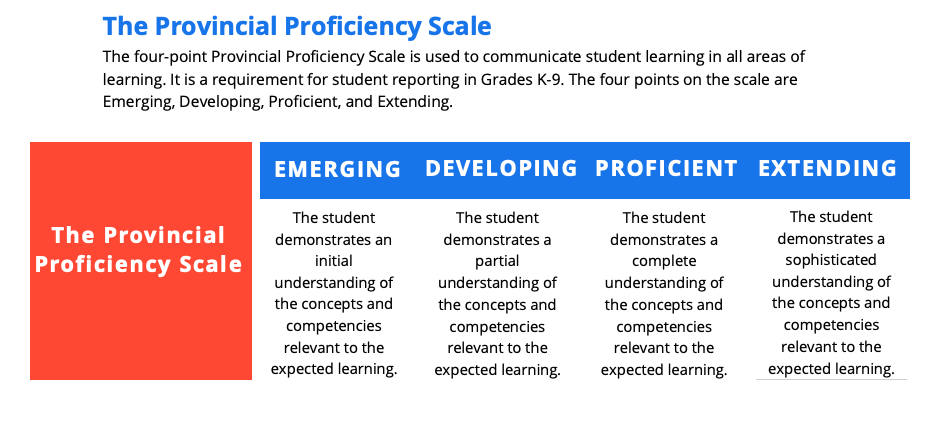
Key Points from the Proficiency Scale from the K-12 Reporting Policy:
- Proficient is not the end of a student’s learning
- Extending does not mean perfection
- Emerging/Developing do not mean failing
- All students learn at different rates and are coming into the classroom at varying levels of proficiency
- If there is not enough evidence to determine where a student is currently at in a given subject, teachers can use the designation IE – insufficient evidence – to indicate the there isn’t enough evidence of learning to determine where the student is at
- Student marks should not be averaged at the end of the term because where they started does not accurately reflect their current understanding/ability – the most recent evidence of learning should carry the most weight
- *Important* The policy includes steps teachers can take to support students at each stage of learning
Example of a Report Card Comment for Literacy:
For an assessment assignment at the beginning of the year, we had to create a report card. Here is the comment a made for a grade 6 student for english language arts, edited to include the designation for the student.
In ELA this term students have been working on exploring a variety of short stories and poetry in order to compare the different uses of literary elements like narrative structure, and literary devices in multiple types of texts.
Susie demonstrated a proficient understanding of different literary elements and techniques and how these devices create and enhance meaning in stories and other writing. Her creative writing piece is proof of her grasp on the different literary devices we covered including simile, metaphor, imagery and personification.
Additionally, Susie is confident sharing her ideas during group discussions of literary texts and is able to combine her viewpoints with her peers in order to build a shared understanding of each text and think deeper about the story.
407 Report Card Assignment_2024
One thing Susie could work on next term is expanding her vocabulary and thinking about the role it plays in building narrative structures and characterization. To do this, I suggest she keep a thesaurus at her desk during writing so she can look up alternative words to help her construct meaning and continue to develop an engaging writing style. Alternatively, reading is another great way to build vocabulary! Further development for Susie will include synthesizing the skills learned this semester and applying them in different contexts to ensure more growth in these areas.
LINKS / EXTRA
K-12 Student Reporting Policy
BC Curriculum
Mini Self-Reflection on Assessment Evolution
This week in another class, we were discussing grades and (paraphrased) our presenter said, “a lot of parents will talk about grades and usually students will repeat what they have heard and say they want to have letter grades because then they ‘know where they’re at,’ but do they really?“
And that has stuck with me over the last few days, thinking back to when I was in school and received letter grades from grade 4 on and wondering did this truly indicate “where I was at” and what I knew. In some cases, I feel like it was an accurate representation but in others I really don’t feel like it did. For example, I feel like I was the student that was able to memorize formulas and facts for tests but did not always understand the concepts behind these formulas. I remember in physics in high school I was able to manipulate formulas to fit certain questions and some hypotheticals but I wasn’t able to apply the information to real life scenarios – even though I got an ‘A.’ In my case, the ‘A’ meant that I tested well and could put numbers into formulas, but did not really reflect my proficiency with the subject matter in terms of what I knew, understood and could do.
Good Reads Assignment Activity
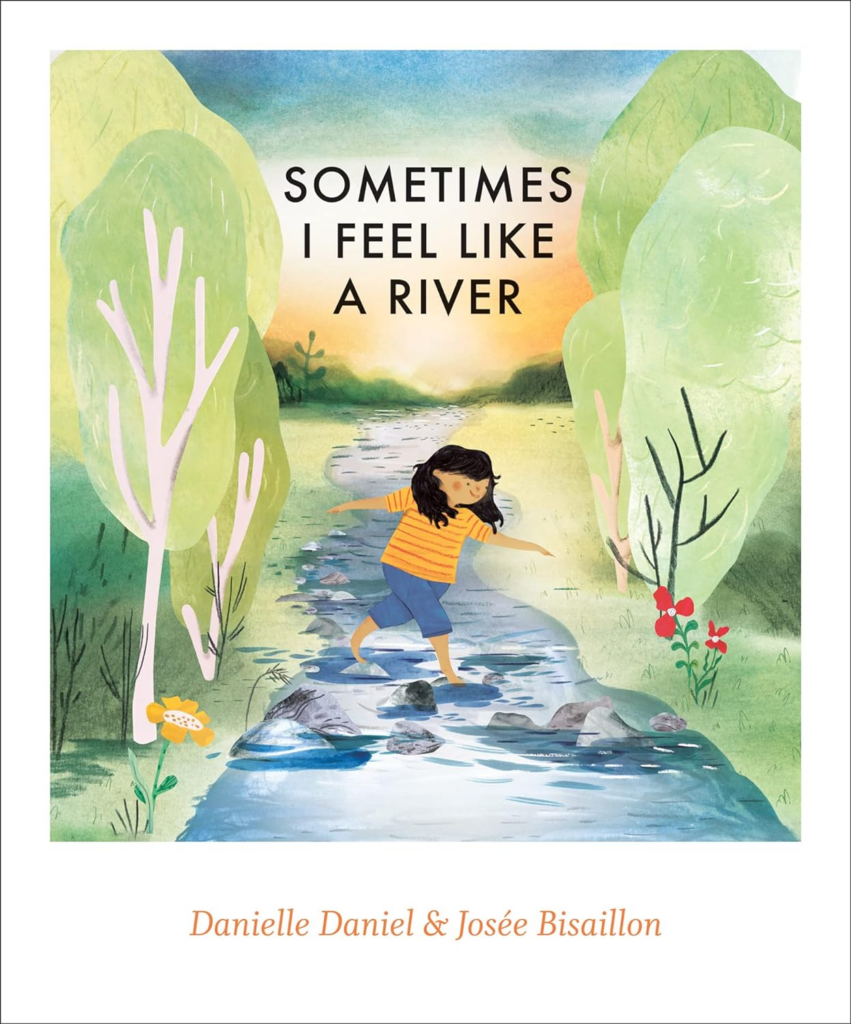
After reading “Sometimes I Feel Like A River” to the class, have students discuss which poem resonated most with them. What natural environment do you identify with? Have students choose a natural feature, waterfall, mountain, forest, river, tree etc that they feel connected to and represents them. They will use watercolours to paint this feature, must include a background. Then, students will write two haikus, including either a simile or metaphor, that follow the line “sometimes I feel like a..” to describe their connection to their chosen natural element. Students will then write their poem onto their painting. Gallery walk to share.
Written Updates Checklist
Summary Checklist
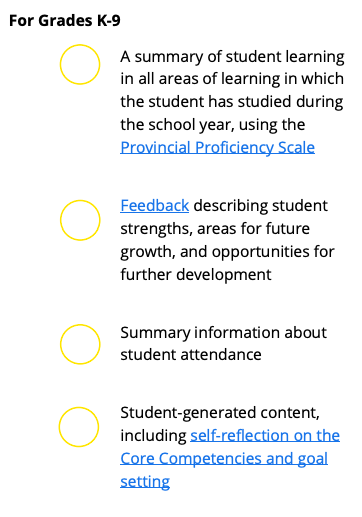
report card comment
from the Reporting Policy