
Class 4: Literacy Mini lesson with reflection
Classroom Routine: Grade 2
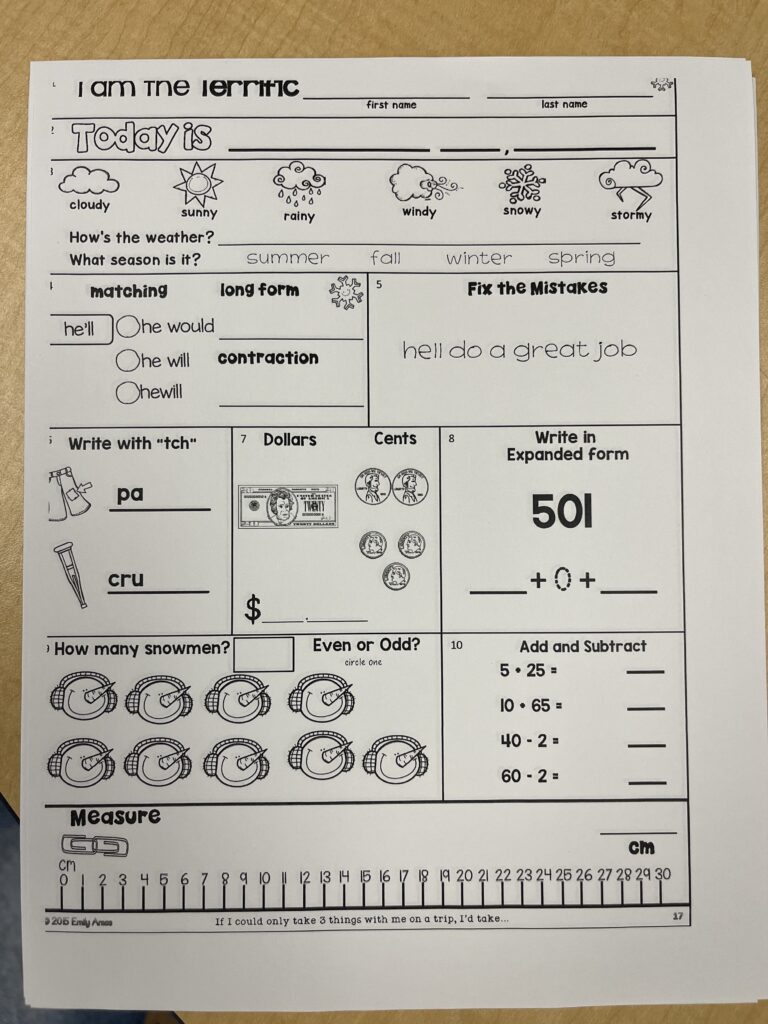
Morning Work: The students have a routine, each morning they complete a one page worksheet called “morning work.” They have done this sheet each morning we were in their classroom. Some students fly through it and when they’re done, they are allowed to draw on the back or silent read. She goes through the sheet as a class after to correct each section or for those who didn’t finish are able to fill in the answers as they go. After they complete this, she gives the class three minutes to draw on the back before they transition to the next activity.
I think this activity is a great way to start the morning and serves as a soft start for the students. It is predictable each morning and the students know exactly what to do so they can start the morning independently. When students know what to expect in the morning, I also find it helps to transition them calmly from home to school.
The sheet touches on math and language arts so students are able to practice those skills in a way that doesn’t feel stressful or rushed like some activities might be. And there is no consequence for not finishing.
I appreciated this activity because of the no pressure element and students won’t feel stressed because it’s routine and they’re never called out or in trouble for not finishing. I liked too that the teacher lets everyone have 3 minutes to draw on the back before they move on. That way the students who aren’t able to finish still get to draw; additionally it makes a great transition to the next activity.
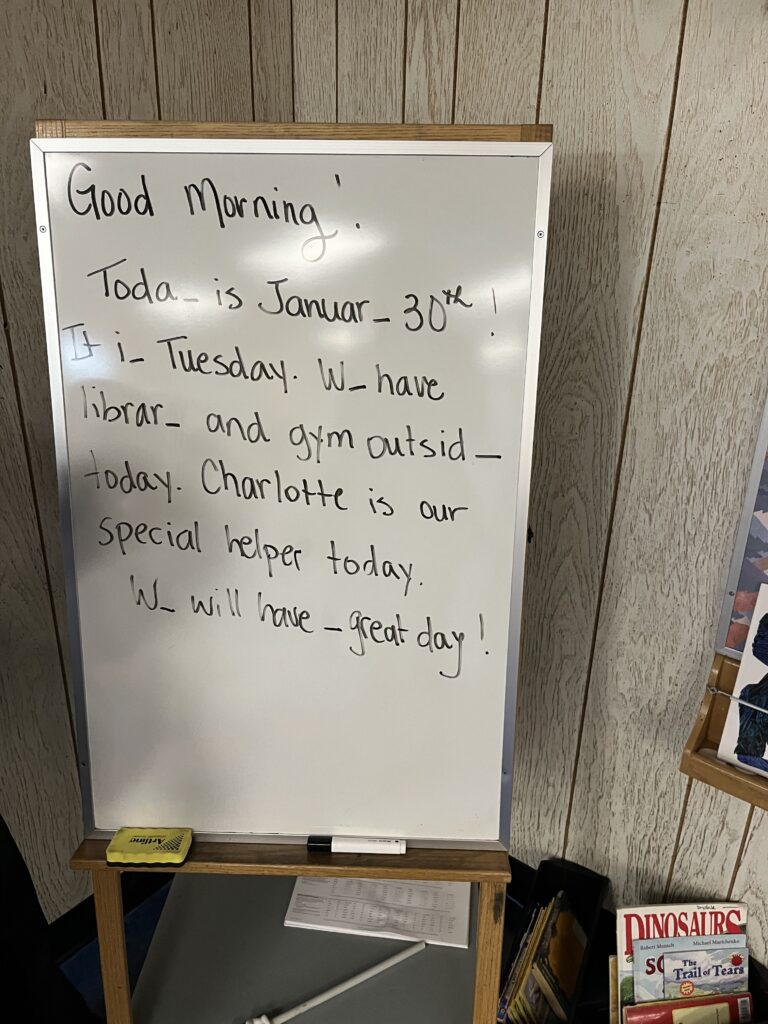
After morning work, the teacher called all the students over to the carpet space for morning meeting. The class reads the morning message all together with the special helper pointing at each word. Then the special helper chooses classmates to come to the front and fill in the missing letter. The last part of morning meeting is calendar. In calendar, the students talked about the weather, days of the week and how many days they had been in school.
Students are learning literacy skills when reading the morning message and they have work together sometimes when a student needs help. There is also a bit of math involved in the calendar portion when students must recognize the number for what day of the month it is, as well as count up to figure out how many days they have been in school.
The next activity we transitioned to was a UFLI lesson. The lesson was conducted at the carpet space on the smart-board. The teacher lead the students through a series of slides that talked about consonant digraphs and the specific digraph they were learning that day: sh. At the carpet, the teacher lead the students through some blending activities with different words that contained the digraph.
Then students were asked to get a whiteboard and go to their table spot to practice writing some words. It followed a pattern similar to what they practiced at carpet, only this time they had to write the word. The students were asked to write the word shin and then to change the -n to an -p to spell ship. And then to change the –i to an –o to spell shop.
This was an opportunity for students to practice spelling, listening to dictation, printing and the digraph they just learned. Students also see how similar words are constructed and how changing one letter will change one of the sounds of the word.
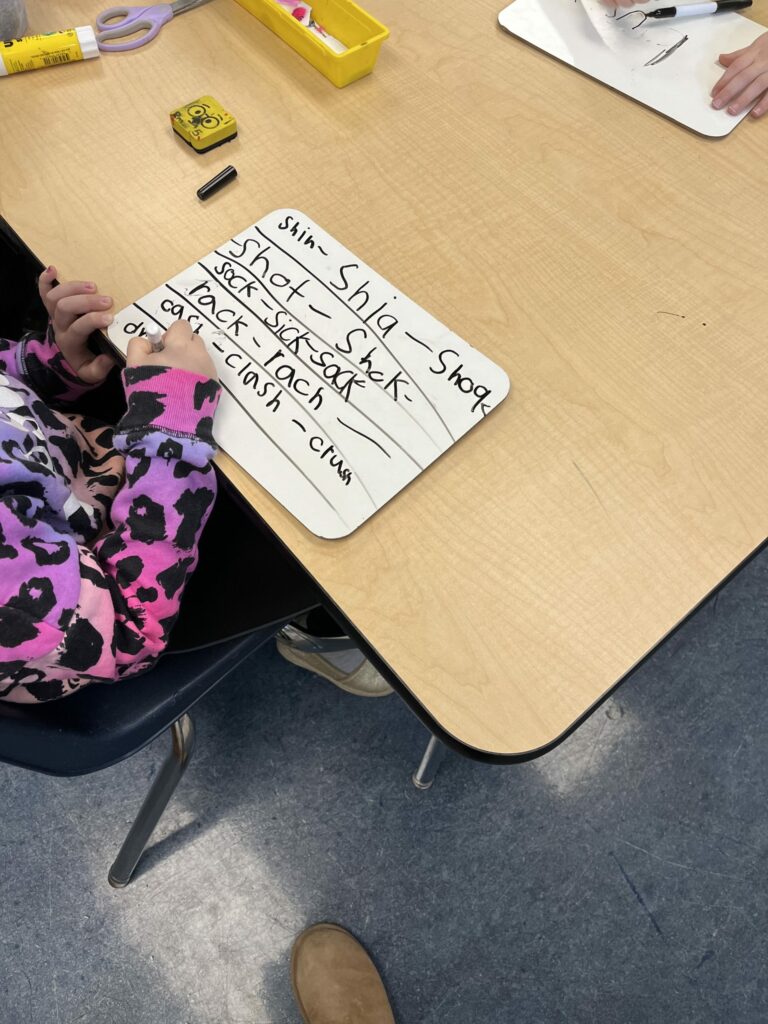
This was great to watch because it showed one way to use UFLI in the classroom and how it works with students. Students were almost all completely engaged. It was beneficial as well because we were able to see things we might miss when we are the classroom teacher. For example, one student fell behind and had trouble catching up and so he was just copying off of his neighbour. He was able to catch up after a few words, but it is just something to be cautious of.
BC Curriculum
https://curriculum.gov.bc.ca/curriculum/english-language-arts/2/core
Throughout the morning, I feel all the core competencies were at least touched on.
Curriculum: ELA and MATH
ELA:
Big idea: Playing with language helps us discover how language works
Content:
- Strategies and processes: reading strategies and writing processes
- Language features, structures and conventions: conventions – common practices in punctuation
Competencies:
- Communicate using sentences and most conventions of Canadian spelling, grammar, and punctuation
MATH:
Big idea: Numbers to 100 represent quantities that can be decomposed into 10’s and 1’s.
- Number concepts to 100
- Direct linear measurement
- Addition and subtraction facts to 20
Curriculum: ELA and Math
ELA:
Big Idea: Playing with language helps us discover how language works
Content:
- Strategies and processes: reading strategies
- Language features, structures and conventions: oral language strategies
Competencies:
- Use developmentally appropriate reading, listening, and viewing strategies to make meaning
MATH:
Big Idea: Numbers to 100 represent quantities that can be decomposed into 10’s and 1’s.
- Number concepts to 100
Curriculum : ELA
Big Idea: Playing with language helps us discover how language works
Content:
- Language features, structures and conventions: word patterns and word families, and letter formation
Competencies:
- Use developmentally appropriate reading, listening and viewing strategies to make meaning